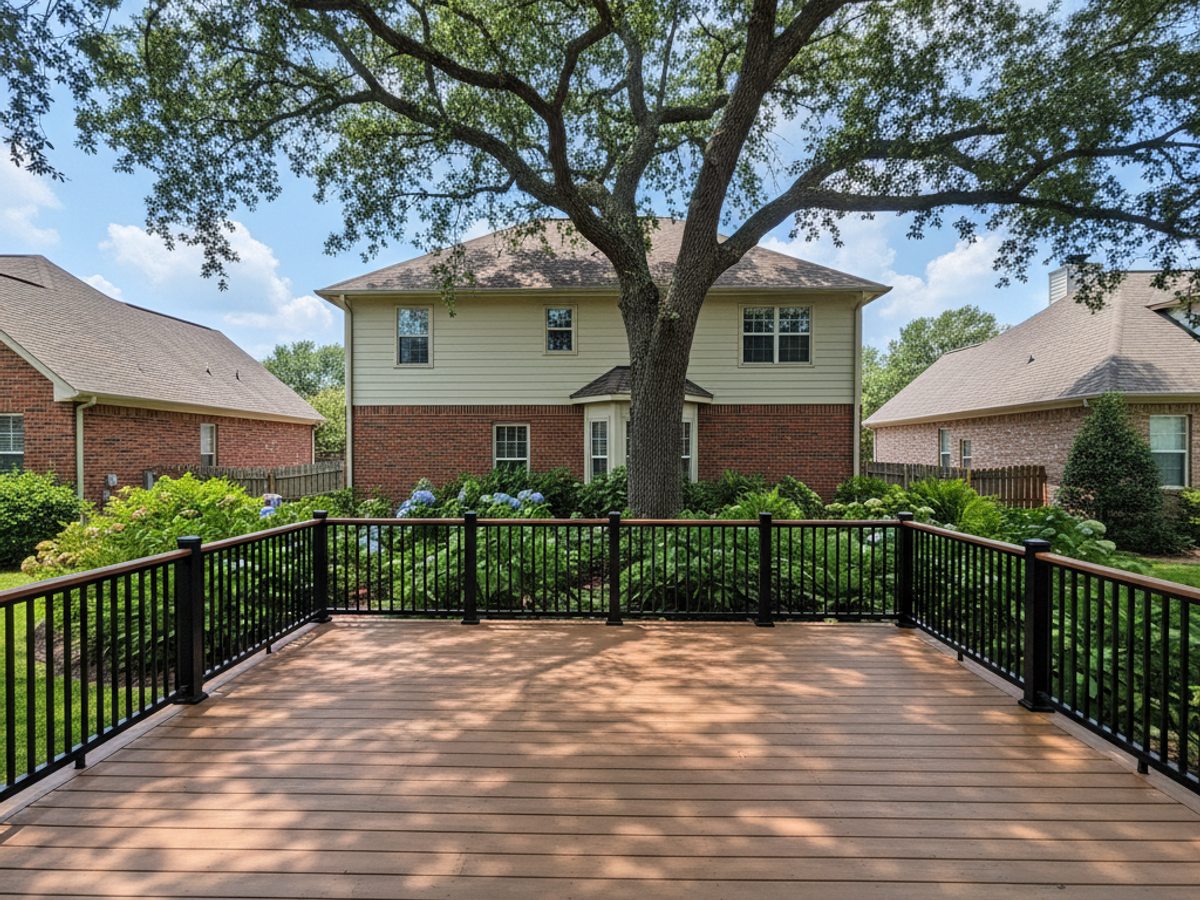
Most deck problems don't show up in year one. They show up in year four or five, when a footing has heaved an inch out of level, or the ledger board has pulled away from the house because nobody flashed it right. The good news is that almost all of it is preventable, and almost all of it can be checked before a shovel goes in the ground. Here's what we look at on a Olive Branch job before we start building anything.
What the ground is actually doing
DeSoto County sits on a mix of clay and loess soil, and the clay content is the part that causes trouble. Clay swells when it's wet and shrinks hard when it dries out, and north Mississippi gets both conditions in the same year. A footing poured on undisturbed clay without enough depth will move with the soil, and a deck that was level in April can be a quarter inch off by August. Local footings generally need to go down around 12 inches below grade, sometimes more depending on the site and the frost line requirement for the county. We dig test holes before we pour, not after, because finding fill dirt or an old tree stump two feet down changes the whole footing plan.
If there's a mature oak or pecan within 15 feet of where the deck is going, we check the roots before we dig footings. Cutting through a major root to set a post can kill the tree over a couple of seasons, and it's a conversation worth having up front rather than after the hole's already dug.
Where the water goes when it rains hard
Memphis-area storms don't mess around in March through May, and a lot of Olive Branch lots were graded for drainage toward the back property line or a side yard swale. Before we design a deck, we watch where water actually moves during a downpour, not where the builder's grading plan says it should. A deck built low over a spot where water pools will rot joists from underneath, usually starting at the end grain where boards meet, long before the top surface shows any damage. We also check gutter downspouts near the build area. A downspout dumping straight under a new deck is one of the most common causes of a soft, spongy spot three years in.
Permits, surveys, and HOA paperwork
Decks above a certain height or attached to the house generally need a permit through the City of Olive Branch or DeSoto County, depending on whether the property is inside city limits. Inspectors typically check the footing depth before it's covered, the ledger attachment, and the framing before boards go down. Skipping that step doesn't save money, it just means the problem surfaces at resale when a buyer's inspector flags an unpermitted structure.
A lot of the newer subdivisions around Olive Branch, especially the ones built since the early 2000s, have an HOA with its own rules on deck height, railing style, or even stain color. Older neighborhoods closer to downtown Olive Branch usually don't have that layer, but they're more likely to have a property line that's never been formally surveyed. If your deck is going near a side or rear setback, it's worth the cost of a survey before you build, not after a neighbor raises the fence line question.
What's already attached to the house
The ledger board, the piece that bolts the deck to the house, is the single most important connection on the whole structure, and it's the one homeowners never think to ask about. On houses built before the mid-1990s, we often find the ledger was nailed instead of lag-bolted, with no flashing behind it at all. Water gets behind that ledger, the rim joist rots from the inside, and nobody sees it until the deck starts to pull away from the siding. If your house is older, expect that ledger to need full replacement and proper flashing as part of the job, not just a few new bolts.
On a newer build, especially in subdivisions where the siding is vinyl or fiber cement, we still pull back the siding to check the house wrap and sheathing before lagging into it. A deck is only as strong as what it's bolted to.
Material, heat, and the calendar
North Mississippi summers run hot and humid, with July and August regularly pushing past 90 degrees with heavy moisture in the air. That matters for two reasons. Pressure-treated lumber needs time to dry out before it will take a stain or sealer properly, usually a few weeks to a couple of months depending on humidity, and staining too early just means the finish peels the next spring. Composite decking doesn't have that problem, but it does expand and contract more than wood with temperature swings, so the gap spacing between boards has to account for a 100-degree range between a January morning and an August afternoon.
Storm season also shapes scheduling more than people expect. A framed deck sitting open through a wet spring week can take on enough moisture to warp joists before the decking even goes down. We try to time framing and decking close together for that reason, especially March through May.
The short version
Check the soil under the footing locations, not just the yard in general. Watch where water moves in a hard rain before you commit to a layout. Confirm whether you need a city or county permit and whether an HOA has a say. Get a property line checked if the deck is anywhere near a setback. And have someone look at what's actually behind your siding before they bolt a ledger to it. Those five things catch most of the problems we get called out to fix years later.
If you want a second set of eyes on a lot before you commit to a design, that's the kind of walkthrough Heritage Deck Solutions does before any contract gets signed.